Total Value of USDT that has Evaded Tether Freezes Exceeds $250M
Funds that slip out of an address between a USDT stablecoin freeze being proposed and executed by Tether have now topped a quarter of a billion dollars.
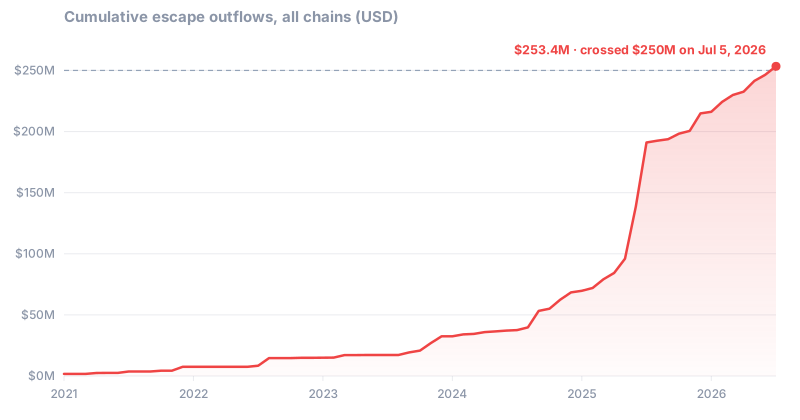
Some time on July 5, 2026, the owner of a Tron address withdrew $3.1 million of USDT while Tether's freeze on it was proposed but not yet executed. With that, the running total of USDT that has escaped this way crossed $250 million. It now stands at $253.4 million, across 587 separate freezes.
What is an escape outflow?
Circle freezes a USDC address with a single transaction: one call, and the address is stuck. Tether does it differently. A USDT freeze on Tron or Ethereum goes through a multisig: one signer broadcasts a proposal to blacklist the address, other signers confirm it, and only the final execution transaction actually flips the switch.
Every step of that process is public, on-chain, the moment it happens. So between the proposal and the execution there is a window in which the target. or anyone running a bot that watches Tether's multisig, knows a freeze is coming and can still move funds. Whatever leaves the address in that window is an escape outflow: money that got away after the freeze was signalled but before it took effect.
Why the window exists
Across the thousands of executed multisig freezes we track, the delay between proposal and execution is usually short - the median is about 2.6 hours - but the average is 1.6 days, dragged out by a long tail of freezes that sat unexecuted for days. That tail is where the big escapes happen.
The window is a side effect of doing freezes safely: multisig means no single compromised key can freeze (or unfreeze) an address, at the cost of coordination time between signers. Circle's one-transaction approach closes the window completely, but concentrates the power to act instantly.
Escape flows are the exception, not the rule: roughly 1 in 18 executed multisig freezes (587 of ~10,500) leaked any value at all.
A quarter of a billion dollars, and counting
Cumulative USD value that left addresses between freeze proposal and execution, 2021–2026.
It took about four and a half years for the first $70 million to escape. Then in 2025 $148 million escaped - more than half of the all-time total - including $95 million in June and July alone, when the two largest escapes ever recorded happened seven weeks apart.
By blockchain, it splits into $164.4 million on Tron (467 freezes) and $89.0 million on Ethereum (120 freezes): the two networks where Tether's multisig operates.
The five largest escapes
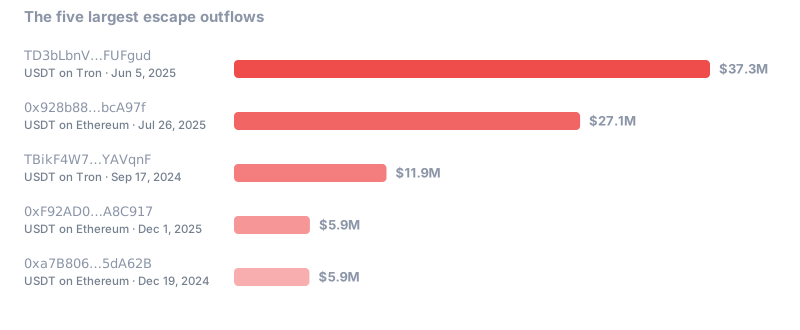
The five largest escape outflows on record. All five are USDT freezes.
$37.3M - Tron, June 5, 2025. The largest escape ever: TD3bLbnVvcvucnJm8uhvVYGwinUzFUFgud drained nearly its entire balance before the freeze executed.
$27.1M - Ethereum, July 26, 2025. 0x928b8864151ee6C1E057964460bf5c7ADDbcA97f, the 14 minutes between proposal and execution were enough for the address to be emptied.
$11.9M - Tron, September 17, 2024. TBikF4W7t6AFbTiA77GgsfXnR8aoYAVqnF, the biggest escape flow of 2024.
$5.9M - Ethereum, December 1, 2025. 0xF92AD00A9185cCf48364e285b875D4E84aA8C917.
$5.9M - Ethereum, December 19, 2024. 0xa7B806757B8ebAfB4C5E09A68A4546d6D55dA62B.
How we measure it
For every executed USDT freeze with a complete on-chain multisig timeline, we reconstruct the address's token balance at the moment of the proposal and at the moment of execution. The value that left the address in between is that event's escape outflow.
You can rank every freeze by escape outflow on the blacklistings page, or see the running total on the stats page. The figures in this post are as of July 10, 2026.